Thursday, February 29, 2024

The Week in Hyperfixations: Different Kinda Zombies

Warm Bodies

While the previous entry shared my proclivity for Zombies of the uppercase breed, I am not by nature a consumer of lowercase zombie entertainment. I am, however, a Hulu subscriber who spent a bored evening scrolling its movie selections and deciding on a whim to watch the one with Nicholas Hoult. I recalled some amusing ads when the movie came out in 2013, but was prepared for something entirely out of my wheelhouse. However, what a charming surprise: minimal body horror content, a gentle romance, and, most startlingly, my favorite theme of all: a story of redemption and restoration. The capper is its small but excellent soundtrack, with "Hungry Heart" one lovely diegetic choice.


Met Walking Tours

I blogged on this very blog yea many years ago of my desire to see a particular exhibition at the Metropolitan Museum of Art, a feat I subsequently accomplished. The same cannot be said of more recent Met exhibitions, like Africa & Byzantium or The Tudors: Art and Majesty in Renaissance England. Enter The Met on YouTube, both the museum's official channel, which offers in-depth 15-25 minute tours of their latest efforts, as well as amateur walking tours. What the latter lack in detail, they make up for in atmosphere. 


Post-Script: The Collection

A January fixation, this 2016 Amazon Prime drama appeared to be a one-off limited series; eight episodes was surely enough to tell the story of the secrets and angsts consuming a post-World War II French fashion label. Until the final minutes of the unresolved finale, when it became horribly clear that no, in fact, it had simply....been canceled.

Regardless, while Apple TV+ can tout its new star-studded biopic series on Christian Dior (one of a few obvious inspirations for the fictional show), it's doubtful that it can offer the lunacy of The Collection, nor the charisma of Tom Riley as uncredited design genius Claude and the fashion displays of Jenna Thiam as ingenue seamstress turned model Nina.

Saturday, April 15, 2023

The Week in Hyperfixations: Cats and Zombies

The Zombies/Colin Blunstone

It's very important that two days ago, I discovered this live cover of "This Old Heart of Mine" (with some...lyrical variation) from a random 1967 French dance show:


I have long classified The Zombies' frontman Colin Blunstone as my favorite vocalist, and I acquired a bulk of the band's 1960s catalogue as long ago as 2009. Still, over the years I've tended to fall into the trap of relistening to the same few songs--though the phrasing on "She's Not There" and "Tell Her No" is, to be sure, exquisite. A recent interview with the remaining band members on Professor of Rock's YouTube channel inspired me to embark on another deep dive, and this time a YouTube playlist, besides exposing the above delight and various demonstrations of the young Blunstone's endearingly awkward stage presence, also introduced me to his solo career. The iTunes review for his second album, Ennismore, notes that he

"recorded several underrated albums in the '70s that deserve to be rediscovered by the same cult that has embraced Nick Drake, another fine singer/songwriter with a knack for the somber and sublime."

The only way this could be more finely calibrated to me is if the reviewer turned out to be Stuart Murdoch. And per debut album One Year, I'm so far agreeing.


24/7 Calico Cats, Cats, Cats!

Five years ago, the Instagram algorithm introduced me to the universe of kitten fostering accounts, and it's become something of a peculiar emotional investment. Early this week, my first foster attachment, fosterkittendiary, shared a link to the TinyKittens HQ YouTube livestream, featuring two heavily pregnant calicoes recently rescued from a feral colony. I've now logged a truly embarrassing number of hours on it, between keeping a tab open on my browser, the YouTube iPhone app, or Roku (giving my own calico a chance to watch on the big screen!) while tracking Orinda's pre-labor roamings and trills, her dramatic day-long delivery, and now the early days of kittenhood while roommate Scotia awaits her own labor, waddles on the window ledge, and absconds with the communal catnip banana.


Post-Script: Daisy Jones & The Six

This was a late March/early April weeklong fixation, as I made my way through the ten-episode series on Amazon Prime over the course of five nights. It was highly enjoyable in the process, and I'm simultaneously fine with the story's having concluded--though it did make me wish for an original, open-ended series about a '70s rock act. The show was strongest when focusing on the creative process--the fragmentary ideas versus the hours of often fruitless focused labor required to bring them to life--joining other series like Mad Men, Halt and Catch Fire, and Fosse/Verdon that excelled in that arena. But the show would also have fallen a little more flat if not for the talents of music producer Blake Mills, who created a decent pastiche of Fleetwood Mac and similar rock acts of the era. (Though the story's focus on the songwriting dynamic between Daisy and Billy sadly meant no full tribute to Christine McVie via the character of British keyboardist Karen.) The incidental soundtrack, featuring a slew of familiar tracks from contemporaneous acts like Roxy Music, Heart, and, indeed, the real Fleetwood Mac, was also stellar.

Tuesday, April 13, 2021

A Call from the Past

Sometime between 2006 and 2007, I wrote this story note, later to be used as a bookmark in a book set aside in January 2008. It resurfaced in the wee hours of March 9, 2021, when I'd finally returned to that book (Albion, if you wondered):


Fun, certainly. Finding it while watching an episode of 12 Monkeys that introduces the idea of a character being born to a time traveler who's living a century earlier than their real time? Well.

Maybe To Say Nothing of the Dog, that life-changing read of late 2002, was the pivotal moment of time travel for my imagination, but I was a fan before--Doomsday Book, Quantum Leap. Still, it must be acknowledged; Leap Years and its variations (Time's Fool came first, I believe) emerged in 2003 for a reason. So since then the world and its rules have served as a minor framework for my own life, actual and creative. These are the tropes of paradox to be avoided. Here is the career agita to invest with more impact.

But I was sidetracked a decade ago, the "real" world of sports--of a sort--overtaking the faculties. Then so much worse; when the small minds and conflicts of media personalities become a source of routine entertainment, the plot's been badly lost.

The silliest thing, of course, was watching Suits from a combination of need for a show to watch, mild interest in the premise, and Markle curiosity. It was weak enough that I set it aside for months between late seasons. Still, one good character; liked her well enough to remember another show she'd done, one a very early friend from that sports fandom had loved, blogged about. 12 Monkeys, time travel; may as well give it a shot.

And a month and a half on, there it is. The emotional investment, the unabashed shipping, the need to know each step, puzzle over clues. It's the disorienting experience of watching a show designed to be discussed six years post its debut; there's no way to communicate the thrill with contemporaneous fans (mustn't catch spoilers in the all-purpose single discussion thread still out there!), no way to speculate without having questions answered before I can even ask them. I'm left to bleat my thoughts on Twitter, keenly feeling the loss of the olde television communities.

And there are the peculiar echoes of Leap Years and novel ideas, the notions I floated a decade and a half ago. A child born out of time. A person brought ahead centuries to the future (now). Modern medicine used to treat a woman who ought to die. Etc. No claims laid to these ideas; it's the funny little itch in the brain is all. It's enough to inspire a challenge of difference. What are my team's goals and dilemmas? Where does my science differ?

And so I revisit the old notes, the messages to myself half-forgotten in meaning, the phrases and songs that once meant a good deal. Even logging into the YouTube account associated with this alias is like journeying to a superior time; video recs are five, seven, twelve years old, from accounts dedicated to long-retired figure skaters, Belle & Sebastian, millennial indie darlings. What was the old timeline meant to become? Or can it be reformed, transfigured, by the now?

Friday, December 9, 2011

Beginning the World: Episode 6 - Quebec City

Well, three years between updates. Seems about right.

Moving on, let's just establish that the previous tour wrapped spectacularly some time in...2009 and then life happened for awhile and now we've crossed the Atlantic into Canada, for reasons. Tour #2 begins in beautiful old Quebec City, Quebec, for reasons that are in part geographic, but mostly inspired by figure skating. Speaking of, thanks for the lovely snow pictures to start us off, International Skating Union on Facebook:


Quebec City's history is the thing, and the Musée de la Civilisation seems as good a place as any to begin. The centerpiece, particularly for our purposes, is Place-Royale, historic grounds which the delightful museum website makes available for virtual tourists through 360 panoramas and extensive commentary. While other onsite exhibits and historic sites have far less of an online presence, but with the information at hand, I would be rather inclined to explore On the Road: The Francophone Odyssey. Though it evokes a few unwelcome memories of long-ago repeated required readings of Longfellow's Evangeline, the fresh historical perspective and promise of interactivity sounds rather irresistible as these things go.

If you prefer to explore a museum while pretending to star in your own Newberry-potential young adult mystery, The Lost Code is at your service. In this engaging little game, visit three museum sites and explore areas to uncover encyclopedic blurbs pertaining to regional history. Gather enough keywords and clues to unlock new levels of further historical exploration! Timesucker? Surely. Good nerdy fun? Indubitably.

Moving along, our next stop is the charmingly named Le Temps Retrouvé. Unfortunately, the charmingly named establishment has no commercial website. It would seem, however, to be an excellent used book and furniture shop, and this is well, though more detail would certainly be welcome. But a photo will serve for now.

Le temps retrouvé - Québec City
Le temps retrouvé by Rick's Pics (Rick Goldman)

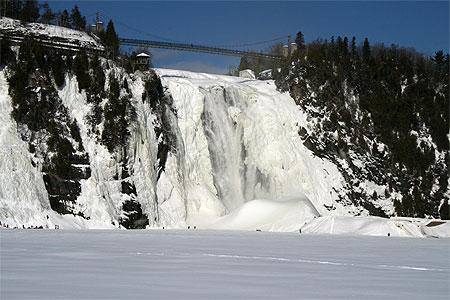
Finally, for some good aesthetic fun, we'll swing by two top visitor destinations. Parc de la Chute-Montmorency -- grander than Niagara Falls and twice as Canadian -- looks to be a spectacular wintertime site. I mean, really.


The opulent Notre-Dame de Quebec Basilica Cathedral, meanwhile, is North America's oldest parish and a National Historic Site of Canada, of which several better pictures can be found here.

But I can't wrap this up without offering links to better resources than I: National Geographic provides an evocative guide, while this video tribute to the joys of winter in Quebec City comes from a TOTALLY IMPARTIAL party.

And now this has become wordy enough that it may simply be easier to conclude with one last pretty, pretty image, before we depart for the next stop on our Grand Canadian Tour:

Monday, December 15, 2008

How to Succeed in the Victorian Literary Industry...

Over the past couple of months, I've checked out several non-fiction books on all sorts of topics that I imagine to be of interest to me -- Modernism! World War I and the arts! The history of children's literature! -- and have, without fail, been unable to finish a single one. Oh, it's not the subject's fault, and it's not really the author's; these are accomplished scholars, you know. Except that, well, "accomplished scholar" doesn't always translate to, er, "engaging writer." Intensive academic work in the field of English doesn't necessarily give one a gift for skillfully manipulating language or a strong sense of narrative; the Stephen Greenblatts of the world are rare. Sometimes the best person to write an insightful literary history is an outsider -- like someone with an academic background in political science and law! But of course!

I first read Daniel Pool's Dickens' Fur Coat and Charlotte's Unanswered Letters: The Rows and Romances of England's Great Victorian Novelists in 1999, and reread it a few times after that, but haven't picked it up since 2002 or so. Ah, the joys of college. In any event, something put me in the mood for a little publishing history, so I started it again two days ago. If possible, I think I love it even more than I thought I did.

The novel as dominant form of popular entertainment really began to emerge in the early decades of Victoria's reign, the 1830s and '40s. (Novels had, of course, existed prior to this point, but, for various reasons outlined in the book, only began to gain genuine respectability as a literary form during this period.) And, like any good form of popular entertainment, the novel -- or, rather, the entire literary industry -- came with a great deal of delightful backstage drama. Pool, in his tremendously readable style, relates the stories of the industry's major players, dealing not only with authors such as Dickens and Marian Evans, AKA George Eliot, but also with key figures in the publishing world, like the painfully young [by which I mean, my age, but doing a job of actual importance] George Smith, champion, publisher, and object of unrequited affection of Charlotte Brontë, or the unscrupulous Mr. Newby, who was fond of selling his wares by confusing the public about issues of authorship and newspaper review attribution. So fond was he, in fact, of leading readers to believe that each latest novel was really written by some better-known author than it really was, that he resorted to printing critical comments such as these in the first edition of Anne Brontë's The Tenant of Wildfell Hall:

"The work is strangely original. It reminds us of Jane Eyre. The author is a Salvator Rosa with his pen." -- Britannia
"We strongly recommend all our readers who love novelty to get this story, for we can promise them they never read anything like it before. It is like
Jane Eyre." -- Douglas Jerrold

Honestly, I can't fault Newby at all, because I'd reprint these gems of critical observation and total lack of irony, too.

Though, fond as I am of Newby's exploits, nay, of all Pool's stories, my heart belongs to the long, awkward saga of William Thackeray and Charlotte Brontë, who seemed to get herself caught up in these sorts of things far more than an introverted clergyman's daughter from the countryside really should have. The two authors initially had something of a mutual admiration society going on: she loved his work, he read Jane Eyre in a day, and she, in turn, wrote a fangirly dedication to him -- whom she had never met, it needs to be noted -- for the book's second edition. In a wonderfully unfortunate twist of fate, however, this dedication also led to the swift devolution of the whole lovefest. Thackeray, as it happened, had a mad wife who had been put away, was raising two young daughters, and relied on a governess for care of the girls. Jane Eyre was subtitled "An Autobiography," and the author's name, "Currer Bell," was known to be pseudonymous. You can see where I'm going with this. Thackeray was furious, Charlotte was mortified, and, well, I'll leave the rest for your own reading. Because you really, really need to read this book.

Really! If you're into Victorian novelists and scandal and all that. And who isn't? At least read it for statements like this:

Was it just Charlotte? Was it that publishers were so sexy? (94)

And for the fact that it would make a bloody good Masterpiece Theatre series, and if someone else doesn't someday adapt it, I will. Couldn't turn out any worse than last season's Billie Piper-miscasting, Jemma Redgrave-wasting Mansfield Park.

Sunday, December 7, 2008

Beginning the World: Episode 5 - London, Part 1

So, ah, we suddenly found lots and lots of things to do in Cambridge and got a bit held up for a time. Yes, that's what happened. Nothing at all to do with my totally falling down on the blog job or anything silly like that. Really, now.

Last time, I promised that our next destination would be the "Ox" half of Oxbridge. Yeah, changed my mind about that one; now we're headed to London! For many weeks, I expect, as there are roughly 379 museums, churches, and otherwise historic sites I intend to explore! And those are just the ones that interest me most!

We'll begin our tour with a visit to what is arguably the world's greatest museum of decorative arts and design: the Victoria & Albert, which actually comprises three separate museums: the V&A proper, the Museum of Childhood, the currently online-only Theatre Collections. The V&A will be our first destination, and we're in luck: it wasn't terribly long ago that much of their deeply awesome website was under some sort of maintenance, but no more; every exhibition site, with all the online galleries and interactive design games contained therein, is now up and running again! Whee!

First up: Ideally, we'd have the option to time travel to 2010-11 to visit the Diaghilev and the Ballets Russes 1900-1939 and Aestheticism: Beauty in Art and Design 1860-1900 exhibits. For some peculiar reason or other, though, the V&A hasn't posted extensive online galleries for these yet. Imagine such a thing! One would think they'd at least have something set up for Magnificence of the Tsars, given that it opens this Wednesday and all, but nooo. Suppose we'll simply have to content ourselves with a little retrospective time travel, then.

Allow me to indulge my historical and aesthetic biases just a bit...

Modernism: Designing a new world 1914-1939 - I'm especially partial to the "Mapping Modernism" page, mainly because it's just fun to slide the little timeline arrow and wave the cursor over the dots indicating designers. I'm easily amused.

This one's already put in an appearance on this blog, way back in my second entry, but may as well post it again: International Arts and Crafts. Not only is there a whole lot of gorgeous among the Exhibition Highlights, but the site also offers a list and directions to nine notable Arts and Crafts-style buildings located in and around London, as well as a map of the museum's Arts and Crafts objects not part of the exhibition. Which doesn't mean much now, given that the exhibition took place in 2005, but it's still quite considerate of them.

Art Deco: 1910-1939. Lots of features here similar to those found on the other two sites, but there's also a quiz, which I aced before even reading through the site. Yay for useless knowledge of early twentieth-century design movements!

As much fun as these exhibition-specific sites may be, nothing at all compares to the time-wasting delight of this little page. For real. I've already created an album cover for my imaginary band (La Belle Indifference, in case anyone wanted to know, for which I provide the imaginary vocals, keyboards, and novelty percussion, and may or may not be fictionally involved with the non-existent guitarist); designed a ring; created my own Modernist poster; created an awfully pretty blue and brown tartan which the site never managed to e-mail me a link to, in spite of the option given to do so, which saddens me greatly, as it really was quite lovely, if totally inauthentic; and designed not one, but two textiles. Behold the result of my attempts at playing William Morris:

Textile 1

Textile 2

Thanks to V&A, it's easy to pretend to have actual artistic ability, even if in reality you can't even draw a straight line with a ruler and can only manage to cut fabric on an arc! Not that, um, anyone is really that lame with regard to spatial reasoning! Ha ha! *cough cough*

Once we've killed 6 or 7 hours with fake arts and crafts projects, it might be worth a trip to the V&A's Theatre Collections. The collections pages themselves are fairly underwhelming -- lots of promises of images that will be posted later this year or sometime in 2009 -- but the subjects page offers plenty of resources on all manner of theatre-related things, which is quite interesting. To me, at least, but that's the way this whole travel show works, isn't it? Mwa-ha-ha.

Next time: More London, I'm sure, but maybe I'd best not make any more promises about this sort of thing.

Sunday, November 9, 2008

Books, and an Addendum to Last Week's Installment

Blah blah blah, currently reading

1. Rites of Spring - Modris Eksteins

and

2. The End of the Affair - Graham Greene

and they're both quite good, but not especially interesting fodder for a blog entry. Also, my 5-year-old laptop decided today to cease to function on any internet-related level; I'm now working with a borrowed and unfamiliar laptop, and its keyboard clickiness and touchpad ultra-sensitivity are freaking me out, as is the presence of a "2/@" key, as my own computer lost its at some point in 2004. All of which is a roundabout way of saying that I'm not quite up for a cursory analysis of a 396-page cultural history of World War I, or of a [considerably briefer] novel on adultery, religion, and death.

What I am up for is a brief continuation of last week's little trip to Cambridge, as we happened to bypass someplace rather important [to me, and probably me alone] while in the region: the district of Huntingdonshire, or, rather, the remnants of the Anglican religious community that once was based there: Little Gidding. I'll refrain from quoting Eliot, since I've already done it ad nauseam on this blog, (but you really still ought to read him). I will, however, just add that this is St. John's Church -- which he visited in 1936, which inspired much of the poem -- in the 1960s, thirty years after that visit but probably not terribly changed:

It's somewhat astonishing to think that such a humble structure could inspire the greatness that is "Little Gidding," yet that's rather the thing, isn't it? The history is what matters;

So, while the fails
On a winter's afternoon, in a secluded chapel
History is now and England. (237-9)

What's that? I went for the quote anyway? And yet I feel remarkably unguilty.